No-hacking vs traditional waterproofing is not a choice between a “good” and “bad” method. Traditional hacking and no-hacking treatment solve different site conditions. The right decision depends on the leak source, the condition of the floor system and how much reconstruction is genuinely necessary.
No-hacking vs traditional waterproofing: key differences
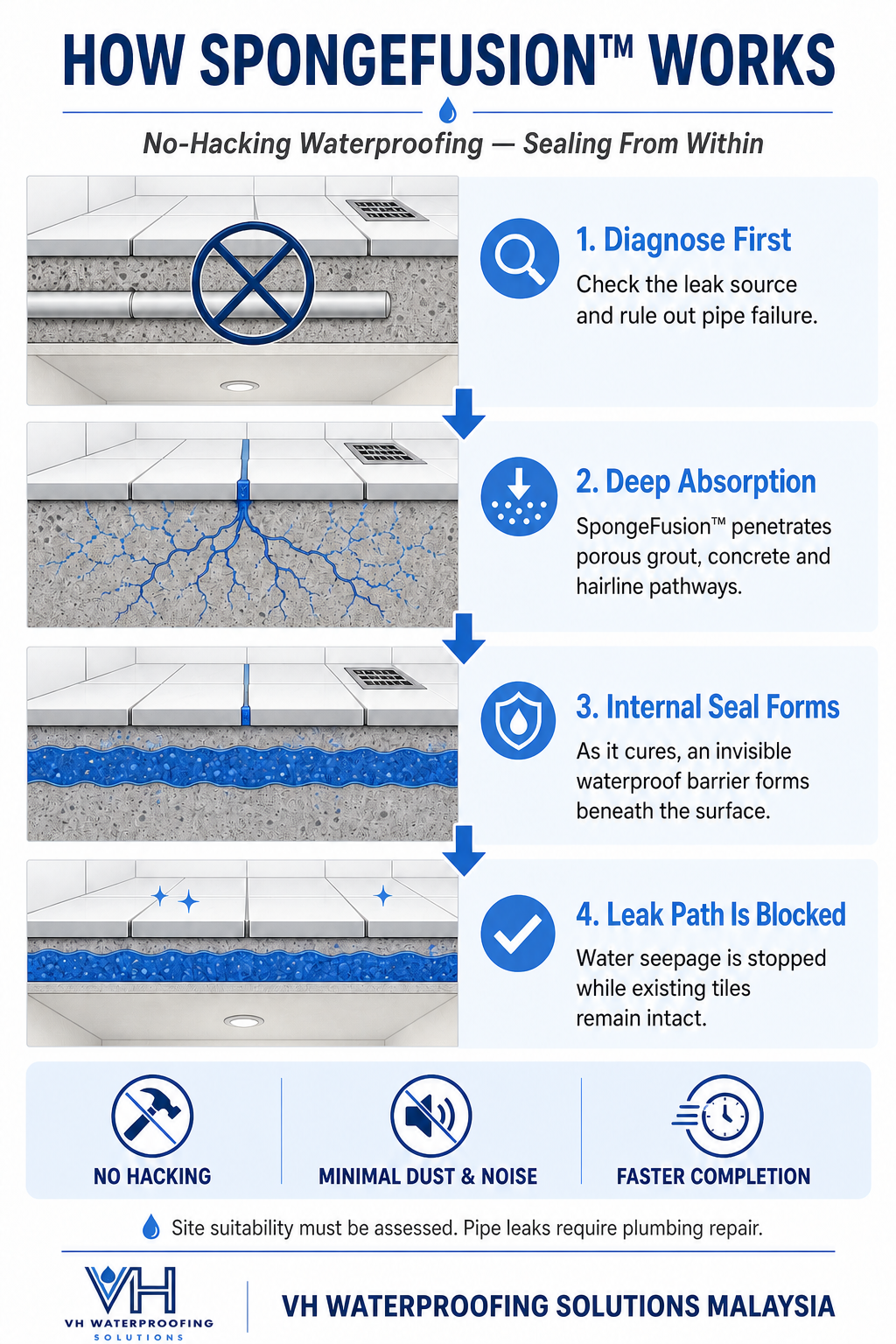
Traditional work typically removes floor tiles and screed so the contractor can expose the substrate, repair defects and install a new waterproofing membrane before reinstating finishes. It provides direct access and is appropriate when the floor build-up is badly damaged or needs reconstruction.
What is no-hacking waterproofing?
A no-hacking waterproofing solution treats suitable porous pathways without removing the existing tiles. VH Waterproofing’s approach uses SpongeFusion™ to penetrate beneath concrete and grout surfaces, helping form protection with less demolition.
Cost comparison
Traditional quotations may include demolition, debris disposal, membrane work, screeding, tiling, sanitary fitting removal and reinstatement. No-hacking work generally avoids many of these items. However, the lowest initial quote is not automatically the best value: an unsuitable treatment that leaves the true source unresolved creates repeat costs.
Time and disruption
| Consideration | No-hacking method | Traditional method |
|---|---|---|
| Tile removal | Usually avoided | Normally required |
| Dust and noise | Lower | Higher during demolition |
| Matching old tiles | Usually not an issue | May be difficult |
| Access to substrate | Limited | Direct |
| Best use | Suitable seepage with stable finishes | Major defects or reconstruction |
Choose no-hacking waterproofing when
- The leak source is compatible with a penetrative treatment.
- Tiles and floor construction remain stable.
- Minimising downtime is important.
- You want to preserve existing finishes.
Choose traditional waterproofing when
- Pipes or drainage below the floor require access.
- Tiles, screed or substrate are severely damaged.
- Falls and drainage need reconstruction.
- Major cracking or structural movement needs repair.
Questions to ask before accepting a quote
- What evidence identifies the source of the leak?
- What areas and defects are included in the scope?
- What must be repaired separately?
- How will the result be checked?
- What aftercare and warranty terms apply?
For a recommendation based on the actual site—not a one-method sales pitch—request a waterproofing assessment.